


Select a location

(KADENA TOWN)


COMING SOON

COMING SOON
TOY MAKING CHALLENGE

This is an educational program that introduces children to the principles
of STEM and basic subjects of classical mechanics through the use of building
blocks and mechanical parts.
Children delve into various facets of basic classical mechanics like laws of physics, forces, energy, torque, leverage, load distribution, and angular momentum and more.

Curriculum Overview
Students learn many different aspects of classical mechanics, including the following: the laws of physics, centrifugal force, centripetal force, force of inertia, kinetic energy, potential energy, law of action-reaction, lift force, torque, leverage points, load distribution, force conservation, angular momentum and more. Participants learn the necessary mathematical skills required in making the scientific calculations needed to build their models.
Objectives
-
Foster planning and time management skills
-
Encourage independent creative thinking
-
Develop one’s ability to analyze engineering processes
-
Broaden knowledge of laws of physics and various natural phenomena
-
Improve spatial recognition
-
Cultivate a sense of self-efficacy
-
Expand interpersonal communication skills

Challenging Models
Amusement park rides
Air crafts
Various types of transportation machines
Cranes
Elevators
Modern machinery

"P" Based Learning
Problem Based Learning: After the construction of a model, our Young Engineers instructors will ask the student to enhance their model in order to solve a given problem demonstrated in that lesson.
Product Based Learning: Students build a product that demonstrates the scientific principles taught in that lesson.
Project Based Learning: Through planning and executing a project from start to finish, students develop their team-building and presentation skills. In addition, they will improve their organizational and time management abilities.
Spiral Learning
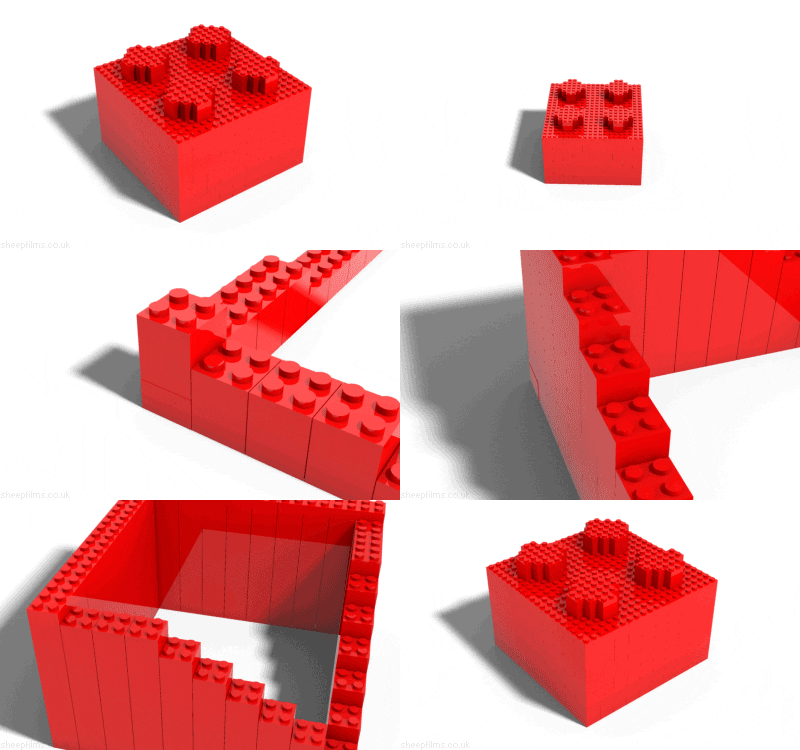
Our instructors teach the principles and terms of a given lesson on a basic level. The next step of the spiral is introducing these principles in new contexts, and then greater depth with each step.


Academic Success
After extensive testing by the Center for Cooperative Advancement, statistics show that students participating in Young Engineers enrichment programs achieve higher grades in all science subjects taught in school.
